Space Invaders Restoration

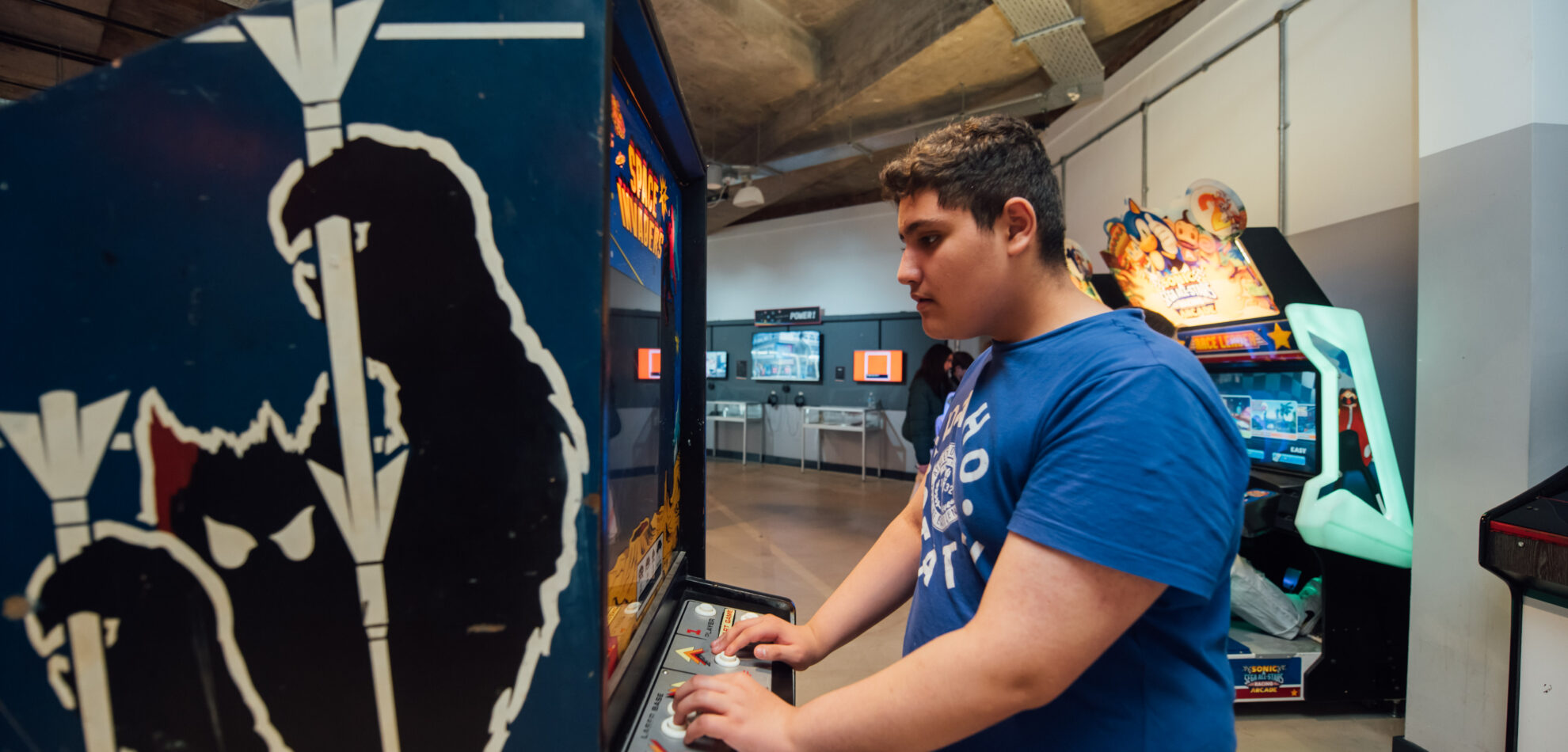
Space Invaders is an all time classic arcade game, it’s truly iconic. Originally released in 1978, the game took the arcades by storm with its simplistic but colourful graphics, fun gameplay and striking cabinet artwork.

Created by Tomohiro Nishikado for Taito, Space Invaders quickly became a gaming phenomenon worldwide, and a pop culture icon. It has featured in arcades, pubs, and amusement parks throughout the years and now also features as part of a new exhibition at Weston Park Museum. 

One of the NVM’s own Space Invaders cabinets is currently on a year’s loan to Weston Park Museum and features in The Boy With a Leg Named Brian: Memoirs by Pete McKee exhibition. 

Space Invaders on loan at Weston Park Museum
Pete McKee Exhibition at Weston Park Museum

A Nostalgia Filled Journey

As one of Sheffield’s best-loved artists, Pete McKee’s brand new and largest solo exhibition to date, takes visitors on a nostalgia-filled journey through his 1970’s childhood. Featuring his artwork, the exhibition is also complemented by displays celebrating the clothes, music and popular culture of the period.

We’re very proud to have played a small part in this display which features our 1978 Space Invaders arcade cabinet. It will be playable throughout the exhibition’s run from the 29th November 2024 – 2nd November 2025.

Acquisitions and Restorations

At the Museum we’re early in the process of acquiring new games, objects and memorabilia to add to our 5,000 plus collection. A recent acquisition was an additional Space Invaders arcade cabinet. As part of the acquisition process our work includes restoration to ensure the object is safe and available to play in the Museum. 

Here we share the process behind bringing a much loved vintage arcade cabinet back to life.

A New Project

The acquisition of a new arcade cabinet always brings excitement to the Museum. These are objects which are now becoming increasingly hard to find and preserve due to age, wear and malfunctioning parts. The process is a true team effort that begins with the acquisition of the object, condition checking the piece, any required restoration work and then exhibiting the object such as in the NVM’s gallery or externally like the aforementioned Pete McKee exhibit.

Our latest object to enter the Museum’s workshop is an original USA import of a Midway Space Invaders cabinet. “It needed some serious care and attention,” our technician Gordie Cavill recalls, as he alongside our Collections Officer, Ann Wain, took the first steps of condition checking the item – an essential part of our Collecting process when we acquire new objects. 

Gordie and Ann with Space Invaders

Cosmetically, the usual wear and tear was expected but an interesting difference to note is the power supply, a job that would need rectifying. “Since it runs on 110 volts,” Gordie says, “the first task was to order a step-down transformer to convert the UK’s 230 volts to the required 110 volts.”

Credit: Gordie Cavill

Powering Up

As with restoring any of the old arcade units, parts often need to be replaced. This could be the capacitors within the motherboard, buttons on the cabinet or in the case of this unit converting its power supply in order to test its working order.

“Once the transformer arrived, it was time to power up the machine,” Gordie recalls. A part of condition checking items is checking whether they still function as intended: After a thorough safety check of the cables and fuses, and the flip of a switch, the screen flickered to life. However, disappointingly the display wasn’t in working order. “I gave it a few minutes to warm up, hoping that would help, and adjusted the vertical and horizontal pots (a feature of arcade monitors that can be used to adjust a monitor’s position). But no luck.”

After being powered down, the next step was solving the display issues.

Research and Testing

With a machine as old as this, the next stages of restoration focused on a lot of research. “I spent hours poring over manuals, online forums, and schematics, trying to diagnose the screen issues,” said Gordie.

Research and testing are important stages in the restoration process, often helping to eliminate potential causes to pinpoint the actual problem. After much testing our technician was able to identify there was a problem with the game board, and not the monitor.

Additional issues to resolve also included the game’s power supply. “Testing the board, I discovered the voltages were way off.” He explains “what should have been 5v, 12v, and -5v were actually reading 7.2v, 9v, and -3v.”

Credit: Gordie Cavill

The power supply board had potentiometers (a resistor that acts as an adjustable voltage divider) to adjust these voltages, and after fine-tuning them back to acceptable ranges, the game finally started running properly. “A few tweaks to the display, and the screen looked great,” Gordie excitedly added.


However, as is usually the case in the delicate restoration process things don’t always go smoothly.

Credit: Gordie Cavill

Rebuilding the Power Supply

Just as things were looking up, the voltages began to drift again, an indicator that the game’s power supply needed more attention. To be expected from a machine that is nearly half a century old, one of the usual issues that often cause faults in the power supply are its capacitors. Replacing several of the capacitors on the game’s power board to stabilize the voltages, Gordie was confident that the game would run smoothly for the long haul.

After a good clean of the board, some additional safety checking and final adjustments, the machine now works exactly like it did back in 1978. A few final tweaks were made to ensure it’s playable without the need of a bag full of 10p coins!

A New Lease of Life

After some more safety checking and final adjustments the machine has been fully restored to working order. “As this is an original arcade machine, there is no option for freeplay, so I wired the 2 player button up to the coin slot to act as a credit button.”

Restored to its former glory, the process is testament to the National Videogame Museum’s mission of ensuring videogame history and culture is preserved, exhibited and shared for all generations to enjoy.