Women’s Representation in Football
Back to exhibitionsWhy FIFA 16?
If there is anything close to a universal game, it is association football (also called soccer, football, fútbol – and fitba for you Scots). From well-manicured parks, to patches of cobbled or concrete pavements in cities and towns around the world, a ball is always being kicked. The sport is fueled by a multibillion industry that promises entertainment and drama pass after pass, goal after goal.
In FIFA, the ball has moved from the physical space to the digital, with profound impacts on the sport and digital industries. FIFA is the world’s longest-running and most commercially successful sports simulation title since its first iteration in 1993. Its commercial success is, in great part, spearheaded by the phenomena of card-collecting game mode FIFA Ultimate Team. Yet, from its early isometric viewpoint and litany of 2D animations of the early 1990s, to the early 3D chunky polygonal animations of the 2000s, through to 2022’s contemporary photorealistic experience, the entire FIFA series is a diverse fleet of games of all differing versions and iterations.
At first glance, and often within the minute-by-minute action of a match, FIFA tries its hardest to make you feel like you are playing the sport. In a very real sense, one of FIFA’s many reasons why it is so popular is that the game series places a significant amount of energy into convincingly simulating the complexities and unpredictabilities of real football. The players you control can perform professional pitch-perfect passes across the park, they can perform skills and tricks at the flick of an analog stick, they can tackle and block shots, and they can score stunning long-range goals from 35 yards outside of the goal.
Yet, in reality, FIFA more explicitly attempts to recreate watching live television coverage of a football match on a Saturday (or given the continued existence of the 3pm blackout, a Super Sunday afternoon). As it has evolved with greater leaps forward in graphical technologies, FIFA devotes more and more attention to detailing the experience of a match day. On the sidelines of the pitch, large television cameras can be seen following the ball and the players. The in-game commentary mimics how pundits and commentators convey the dramatic flow of a match in modern broadcasting. Even the in-game scoreline is positioned to the top left corner of the screen, exactly in the same place that you would see when watching a live game. So for all its effort in making you feel as though you control the game, FIFA excels in making you the arch director and producer of a live game of football for a broadcast audience of millions of people.
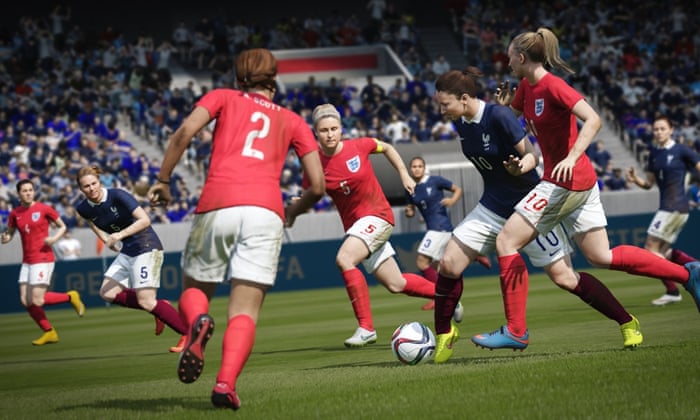
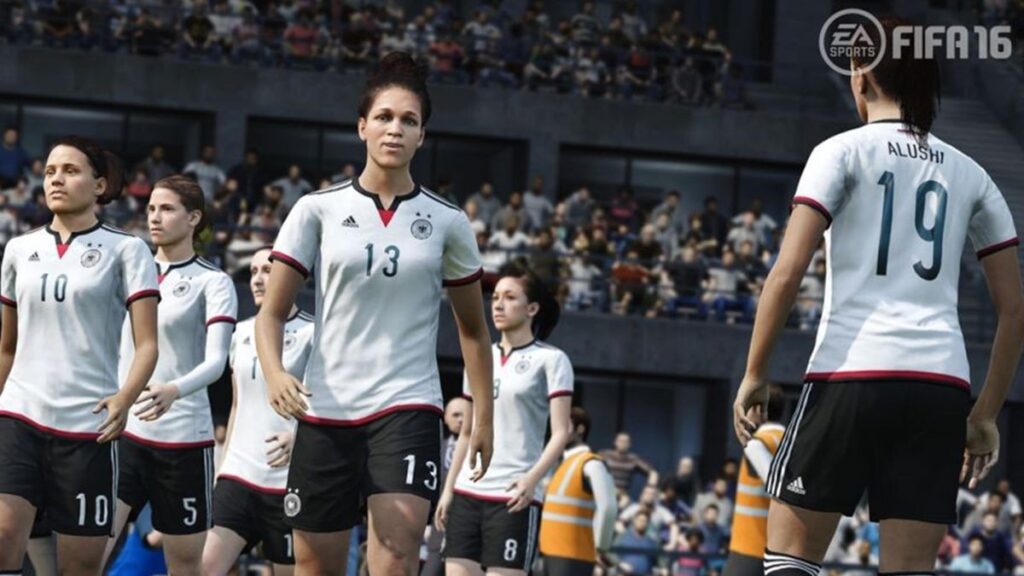
It is worth asking that, in the face of almost thirty titles, why is FIFA 16 so unique? Why was FIFA 16 chosen to be showcased at the National Videogame Museum? Well, FIFA 16 is a groundbreaking release for social representation. It was the first title in the series to introduce playable women’s national football teams. 12 women’s national teams, including England, France, and the USA, are made playable. From FIFA 16, the series’ virtual take on the sport was no longer an all-male space. FIFA 16’s inclusion of women is another landmark moment in the history of women’s football.
In previous iterations of the series, women were marginalized into pixelated spectators, passively observing a sport that was exclusively dominated by men. This exclusion was partly a product of global bans on women’s football. On 5 December 1921 the English FA condemned women’s football to the margins of society, passing a resolution that stated: “The council feel impelled to express their strong opinion that the game of football is quite unsuitable for females and ought not to be encouraged…The council requests the clubs belonging to the association refuse the use of their club grounds for such matches”.
Before 1921, women’s football was incredibly popular with players and spectators.The British Ladies Football Club, founded by Nettie Honeyball in 1894, were responsible for arranging an English North versus English South match in London in 1895 with a crowd of 10,000. Britain’s most recognisable women’s team at this time was Dick, Kerr Ladies, a Preston-based team led by women workers from a train and tramcar factory. In Lily Parr, the team possessed a talismanic striker who was the most famous women’s football player of the time. The team travelled across the world to play showcase football matches in Europe, Canada, and the United States. By 1921, the Dick, Kerr Ladies were booked to play an average of two games a week. Through this period, almost 900,000 people came to watch the team.
The FA ban – which lasted between 1921 and 1971 – effectively destroyed women’s football as an organised pursuit. Despite the ban, spectators still wanted to watch women’s football; at New Brighton on 27 December 1921, 7,000 people witnessed a match between St Helens and Dick, Kerr Ladies. This collective public will to engage in women’s football is evident in how the sport survived across the middle of the twentieth century. In 1970, a women’s team known as Corinthians Nomads took part in an unofficial match against Dundalk Ladies at Prestatyn Raceway in north Wales. In the same year, the first unofficial World Cup tournament was held in Italy. England’s international team, although never winning a major tournament officially recognised by FIFA, won the Mundialito tournament twice in 1985 and 1988. These stories are emblematic of women’s football operating in the margins of society through the notion of limited inclusion – partial raising of the barriers for women to give them the opportunities to play football that were wholly controlled by men and the prevalent societal attitudes that were residual from the 1921 ban.
FIFA 16 has a crucial role in this history. Before FIFA 16, there had been public anticipation for the inclusion of women’s football. In 2013, the series was criticised for its continued exclusion of women through an online petition organised by the Spanish national team captain Vero Boquete. Across FIFA 16’s global release, three women players featured on the game’s cover. While Alex Morgan appears on the American cover, Canadian forward Christine Sinclair and Australian defender Stephanie Catley are present on the Canadian and Australian covers. Yet, FIFA 16 exists as an exception to the rule; the only iteration of the 28-game series which features women players on the cover.
Ultimately, FIFA is a series brimming with historical stories. While we have focused on FIFA 16 at this moment in the National Videogame Museum, many titles within the series contain their own significant stories and interpretations of our past. From making you feel like you are Lionel Messi or Christen Press, to showcasing how modern live football broadcast is seen on our TVs, FIFA is truly a site of videogame history.