This edition of our ‘Object of the Month’ series showcases a mysterious blank cassette tape…with a ZX Spectrum connection, as we celebrate its 40th anniversary of one of the nation’s most important home computers! It also lends tribute to its co-creator Sir Clive Sinclair – who passed away on 16 September 2021.

Many books on the history of the videogame industry focus on the United States. Yet, while the country undoubtedly plays a central role in how the videogames industry evolved, when it comes to documenting the 1980s, these US-focused histories do not produce compelling accounts of videogame history in Europe.

This difference is formed because the gaming experience of the United States is influenced by the so-called “crash of 1983”: a large-scale recession in the videogame industry that was predominantly isolated to the country. In contrast, throughout the 1980s, the United Kingdom and Europe saw a huge surge in popularity of the home computer.

Blank cassette tape (2003)


As a result, the ZX Spectrum stands as a historic testament to a brief moment in time when home computers were the primary way for people to play videogames. The ZX Spectrum – along with its fierce rival the Commodore 64 – is a wonderful symbol of the 1980s as the real crucible of the expansion and success of the British gaming industry.

Produced by Sir Clive Sinclair and designed by Richard Altwasser, the ZX Spectrum was an 8-bit machine that aimed to be the market’s most affordable full-colour home computer. The notion of an ‘8-bit’ computer refers to the amount of colours that can be displayed on the screen, with 8-bit translating into a whopping 256 colours! 

ZX Spectrum (1982). Developer: Sinclair Research Manufacturer: Timex Corporation

As you can see on the machine’s plastic casing, the now-iconic rainbow design symbolises the ZX Spectrum’s ability to display full colour. And even the name of the console demonstrated that new owners now had access to a full ‘spectrum’ of colour options. So, for all this talk of the computer, what is this blank cassette object? Well, during the 1980s, home computer software was typically distributed on audio cassette tapes. Yes, you read that correctly. Before the days of the digital download, or the CD-rom or Blu-Ray disc, games were made playable by those defunct music cassette tapes! From Monty on the Run (a shining example of Sheffield’s illustrious gaming history) to Jet Set Willy, the greatest ZX Spectrum titles were all housed on a cassette tape.

The Jet Set Willy…set, complete with software protection card and cassette (1984)

Cassettes are made of magnetic reels of tape in a small plastic casing that enable sound to be played and recorded. The tapes that were used with early game machines are exactly the same tapes that your parents (or older siblings, or grandparents) might have used for listening to music at home: or on-the-go if they had a portable cassette player. These cassette tapes could easily be copied by using a cassette recorder: a device containing two tape players (also known as tape decks). To record music onto a blank cassette tape, one deck ‘played back’ the tape, while the other recorded its audio output. 

As the 1980s progressed, tape-to-tape devices became more commonplace in households through affordable mass market hi-fi systems. Consequently, the process of copying music – and games – became a lot more straightforward. Cue millions of lovestruck 1980s teenagers creating curated mixtapes featuring The Cure and Kirsty MacColl to give to their high-school crush…but also cue thousands of ‘pirates’ copying games and distributing them. If you were in the business of making videogames, the ability for people to easily make copies of your hard work and share them without paying was not a good development.

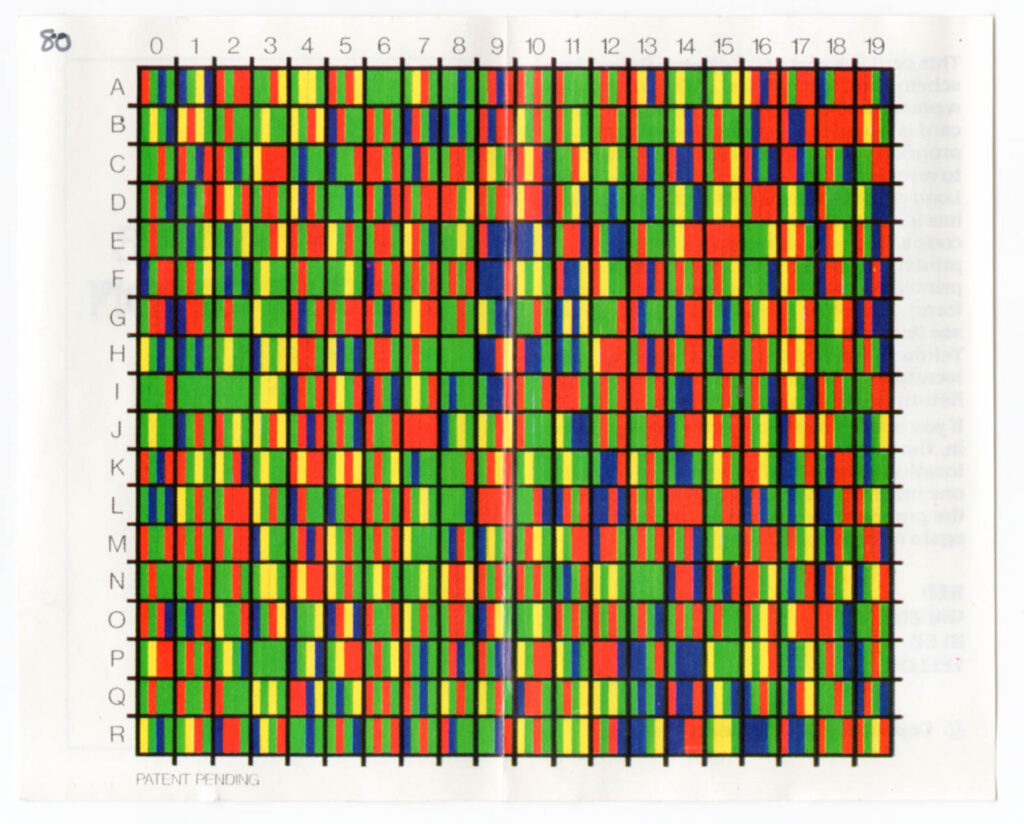
In 1984, Liverpool-based publisher Software Projects produced an ingenious way of stopping people making illegal copies of their new game Jet Set Willy. Without a way to stop people copying the game, they decided to make legitimate copies of the title harder to use and duplicate. As a clever solution, they packaged each copy of Jet Set Willy with a ‘Software Protection Card’. Each card contains a grid of boxes each of which contain four apparently randomly selected coloured bars. As soon as the game loads, the player is given a grid reference and asked to enter the combination colours. If the combination is entered correctly, the game starts. But, enter the wrong combination twice in a row and the computer and the game refuses to continue and the computer automatically restarts. 

Software protection card (1984), Software Projects

In theory, players could manage to get a lucky guess, but there were so many possible combinations that, in practice, unless you had the card, your copy of the game was unusable. The key idea behind the ‘Software Protection Card’ was that it would be too time-consuming for pirates to copy out by hand. Additionally, the colours on the card had been carefully chosen so that the modern fleet of 1980s photocopiers could not accurately reproduce them. Therefore, in an age before digital cameras or smartphones, super expensive and cutting-edge colour photocopiers or a handful of felt-tipped pens and plenty of spare time were the only options to try to obtain a ‘sus’ copy of Jet Set Willy.

And Yet. There is still an elephant in the National Videogame Museum, so to speak. And in this case, the elephant is potentially located in one of our very own ZX Spectrums. It all links back to the blank cassette. Demonstrating playable ZX Spectrum games at the National Videogame Museum is actually pretty tough. This difficulty is a product of the machine’s venerable age. Preserving these plastic and electric components and materials is an uphill task against natural ageing, and many of the parts inside the ZX Spectrum are continually degrading and sometimes needing emergency expert repair. 

That’s why, for our visitors, we use emulation to make the ZX Spectrum. *shocked noises from the audience* Are we here at the NVM no better than the 1980s pirates copying cassettes of 1983’s Manic Miner?…Well, we don’t think so. While we don’t use emulation for all of our playable exhibits, we happen to think that the notion of ‘emulation’ should not be an entirely unspoken concept. In fact, we use a variety of emulation forms at the museum. For instance, we often use a compact flash-memory device that is preloaded into ZX Spectrum to make games load quickly for our visitors. For the majority of our needs, we use emulation software through the powerful but diminutive single-board computer Raspberry Pi. By using such a useful and discreet computer, we can create really creative and unique exhibits – such as Platform 14 – and offer our visitors a distinct opportunity to play these older games in diverse ways, all without further damaging these historic machines. 

Ultimately, in their own way, these blank cassettes are a historic symbol of game preservation, demonstrating how fans and players interacted with the medium during a period of time when British and European gaming was in the ascendancy. The blank cassette is also a modern reminder that the murky waters of piracy have also provided a unique solution to the question: ‘how do we make older games easily playable in a museum setting?’. The blank cassette reminds us that emulation is a wonderful solution and an educative tool. It is not the flagship of the pirate’s fleet.

Object of the Month

Videogames aren’t just code! Every month, we select an object from our collection for you to explore…

See all objects